Friday, May 30, 2014

Coal Creek

May 29, 2014 I went on a field trip to Coal Creek.  


We have hundreds (if not thousands) of old mines here and this may well be a solution for returning those scarred slopes back to what they once were- alpine meadow and grassland.

Photo Brian McMullen 
Soil Scientist- White River National Forest


No, you probably haven't heard of it but I hope a lot more people will hear about it and we can start this process throughout the Western US.

Here's an overview of the  Coal Basin Project

…. or as  Scott Snelson calls it "the biochar grazing nexus" .  Scott was District Ranger of the White River National Forest at the start of this project.  


Youtube is being uncooperative this morning- so you'll need to click. If you want to read the Aspen Times article on Scott without feeding the marketing machine then go to the link on a tablet or a smart phone. aspentimes.com/article


The group yesterday was impressive. We had representatives from Pitkin County, the Town of Carbondale, The National Forest, the Roaring Fork Conservancy, Roaring Fork Water Shed Plan  and The Crystal River Cattlemen's Association to name a few. Soil Scientists and Geologists who have been monitoring the project were also there. The short version- this represented a lot of cooperation between Federal Government, County Governments (both Pitkin and Garfield), City Government, Private enterprise and non-profit Organizations.  Cooperation and collaboration between agencies and individuals for mutual benefit - what a concept. That may well be the most heartening part of this story.

We met at the Coke Ovens at Redstone.

and we carpooled up the Coal Creek Basin.

Here's Wayne Ives of the White River National Forest giving us an overview at our first stop. 

This was an area which was covered in mining "slag" 

Photo Brian McMullen 
Soil Scientist- White River National Forest


much like the Hope Mine on Castle Creek. 


Unlike the Hope Mine this area had traditional grazing on it until about 30 years ago.

So what did the "Coal Basin Restoration Project" do? They used Cattle, Compost, Cattle Stomp and Biochar to restore something which used to look like this:

into something which looks like this

What you're looking at is an acre which has 2 different treatments. Both involve cattle and both involve "seed stomping" one has biochar the other does not.

Here's the process. 

noxious weed control.
a 17th century cure for baldness, dog attacks and hemorrhoids but still a noxious weed.

(Weeds of the West- excellent book)


Then they spread 3" of compost  and then covered it with hay, "White River National Forest seed mix" and straw.  

Photo Brian McMullen 
Soil Scientist- White River National Forest


On half the compost had an additional 5% biochar  other than that the process was the same. 

Then came the cattle. 

Photo Brian McMullen 
Soil Scientist- White River National Forest


The cattle "stomped" the White River National Forest seed mix in, ate the hay and left the straw for cover (aka "litter). The cattle also left behind fertilizer and hoof prints (I'll get back to that later)

Take a closer look….


You see the distinct change in color in the soil?

That's the biochar.


That's moisture retention.
That's gold.

Compost, Hay, Straw, Seeds and Cattle *without* biochar.

Compost, Hay, Straw, Seeds and Cattle *with* biochar.

Each hoof print creates a microclimate which provides shade and a place for water to pool.


Here's the microclimate without biochar.

Here's the microclimate with biochar.

Photo Brian McMullen 
Soil Scientist- White River National Forest


Got it?

Okay…. up the road a bit… and this time take the cattle out of the process...
Start with what's left over from an avalanche on the road (shale washed down from the cliffs above)
..bring in the machines


to give you some furrows to impede erosion and give the water someplace to settle…

3" of compost with no biochar

3" of compost with 5% biochar

Photo Brian McMullen 
Soil Scientist- White River National Forest


in case you were wondering...

 what 1" of compost with biochar will do…

what 3" of compost and biochar will do

There are a lot of elements to this experiment. 

There are plots growing native grasses and forbs under controlled conditions. 
Photo Brian McMullen 
Soil Scientist- White River National Forest


(These "bioislands" were planted by Garfield County prison inmates.)


There are sediment monitors on the creek
(There is a lot of sediment in that water- I mean a lot…) 


and soil moisture monitors in the ground.
The tubes go into the ground for control,  non-biochar and biochar compost sections.

Soil moisture monitor at 2", 8" and 20" of depth.

Here's the data- the process doubles the moisture content 

(or more- I'll give you exact figures as soon as I get them).


It's our choice, slag and erosion or


Grass.

Here's more information on the Cattle Stomp and  using the Savory Method to reverse desertification in the links; and here's info on Biochar from Morgan Williams at the 2012 ACES talk (youtube- get your act together please….) click here for the video.

Thanks to Mark Lacy for letting me use these reports from the White River National Forest and The Roaring Fork Conservancy:


Thanks to Brian McMullen for letting me use images from his PowerPoint presentation.


Saturday, May 24, 2014

Groasis redux

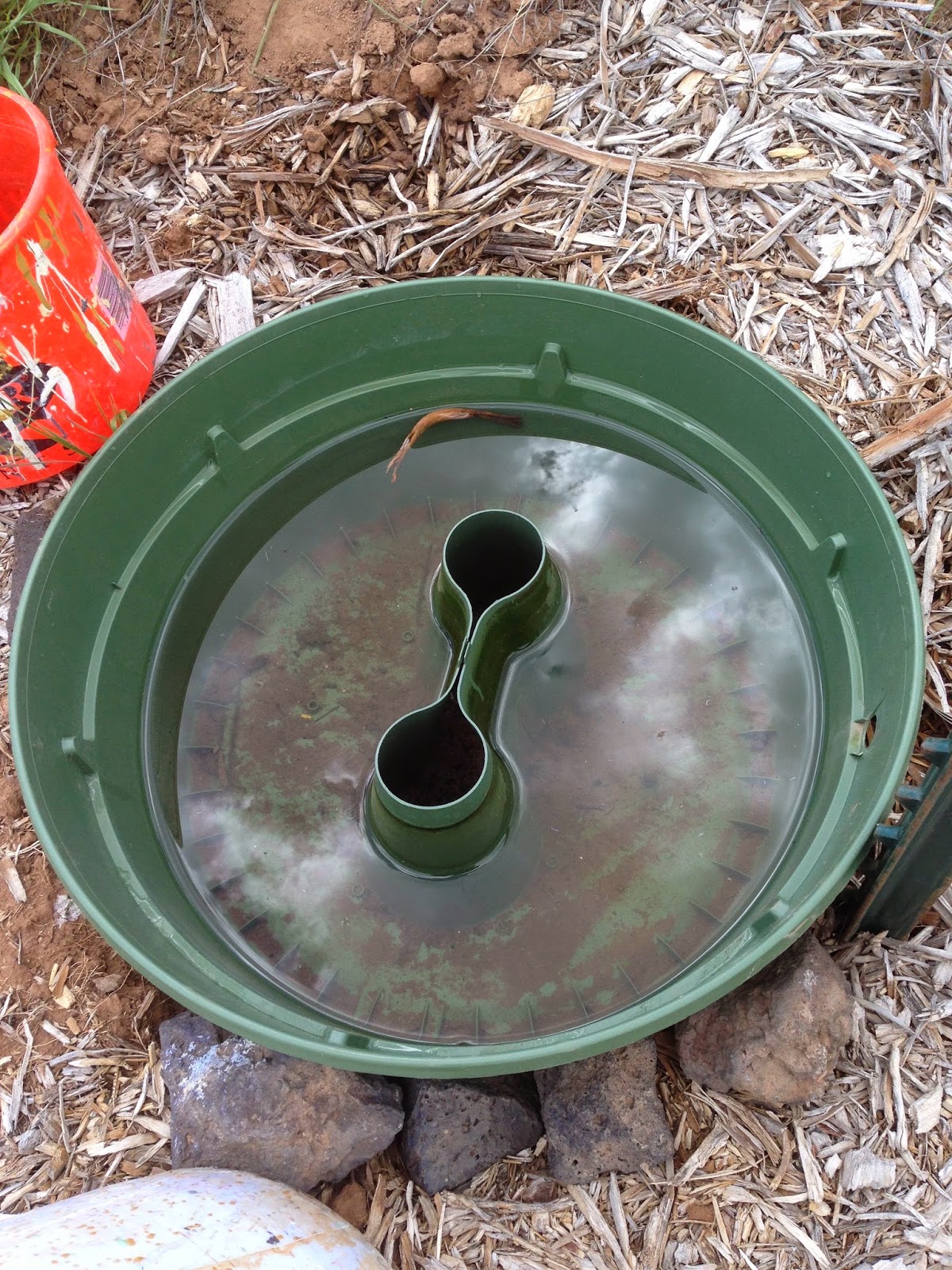
Okay, one year later and where are we with the Groasis waterboxxes?

One bare root choke cherry from Cold Stream Farm has made it and is looking *fabulous*


in case you've forgotten this is what it looked like last June:


The teensy choke cherries which I planted last fall are also hanging in there
I didn't expect growth over the winter ...


and I didn't get it- but they're not dead and there is some green for Spring.    


The boxes are holding water well:


but I think if I put in anymore I'll silicone around the wick on all of them…


This one had root infiltration and sucked the water which should have gone to the baby choke cherries. 

The other thing I'm trying is planting a  third seedling in each box. After listening to "To the Best of Our Knowledge." and their excellent program on "The Secret Language of Plants" with Suzanne Simard I'm hoping for some cooperation between seedlings so maybe those who get more sunlight will share. (Here's what a bare root tree from Cold Stream Farm looks like when you get it.)


Overall, it could be better it could be worse. There's no question that if you keep the native grass roots out of the waterboxx that the seedlings or the bare root trees will grow. The other factors seem to be getting a good bare root tree to start which is tall enough to get some sunlight and making sure deer don't eat that little baby tree once it starts to turn green.

It's certainly cheaper than running irrigation over to a remote part of the property. It's really not that labor intensive; and it's a smart use of water. The box does trap snow and rain well. I don't know if the condensation is working as well in practice as in theory but the point is there is water year round. In June and July that's very important in the high country desert of the Western U.S. 

The dirt (and I use the term loosely- since it's really compacted clay) looks good- damp- holding water well- and under one box - *worms*!!! (worms are good).

My conclusion would be if you're not in a hurry to see full grown trees overnight this one is worth a try.


Tuesday, April 1, 2014

Elixir

Since I've written about "work" I though I might as well show you some.


Allen Moyer asked me to work as his assistant for a production of Elixir of Love which will be produced at the Saint Louis Opera this summer (2014).

Allen's scale model using the rendering from the San Francisco production.


It's a project I've worked on with him before for the Colorado Opera and the San Francisco Opera. For those two productions I was the Scenic Artist/Scenic Supplier as well (that means I not only painted the scale rendering but painted the full scale pieces in my studio)


Here's a record of painting the scale rendering for this production:

It's all based on Grant Wood paintings. The first job was to create a composition which fit onto the stage using Grant Wood as inspiration and scans from the previous show curtains. This was done in photoshop:

A little perspective fiddling had to be done to get everything to sit on the ground together.


This was going to be 3 walls. The total width 70'. We settled on 3/4" scale because of the size of illustration board available and the level of detail needed in the rendering. I was a bit concerned with that since I wouldn't be painting it myself and all the "shorthand" I'd used in the previous renderings needed to be written out longhand this time.

I printed out the photoshop piece at 3/4" scale onto vellum and then transferred the "cartoon" to board. I do this the old fashioned way with a paper I've rubbed with graphite. Store bought transfer papers leave a greasy mark where you've applied pressure which acts as a "resist" to the paint. 

After transferring the design to hot press watercolor board it was time to start. I prefer hot press because cold press is a  textured surface.  It's much easier to get a good calligraphic line on a smooth surface (and Scenic materials are normally smooth as well). This is 3 boards taped together.  

This is Cresent brand board. I like Strathmore *a lot* better it's got a tougher skin and absorbs better. The Cresent pulled up under some of the masking fluid (not good).  

Since it's watercolor it will always be highlights first- shadows after.

I did this in 6 hour days. That's primarily because the light was right for 6 hours. Too early or too late and the colors start to change. 

Day 2

Day 3. There's endless detail in Grant Wood you just have to pull back and stop at some point.


Day 4 and I start to fill in the fields. 

I've used masking fluid (rubber cement) to cover the people in the fields.


Finally on day 5 it's beginning to look like something.


Now on Day 6 it's time for some "sweetening"


I cover the entire painting in masking film and start peeling back specific areas. Actually this is from my stash of Zipatone Parapaque photographic blocking film- it's much better than low tack masking film but no longer available.


These areas are spattered with color to add depth,


  and texture.


Then it's time to pull all the masking film off and do a few touch ups…


and then off to FedX


I hope to post pictures of the full scale production later this summer.


Here's a little taste from the San Francisco production.

This is a big challenge to light since it has so many delicate colors and it's difficult not to have something go to mud during a cue. If you want to see how Paul Palazzo solved that problem- buy the dvd.


Wednesday, March 26, 2014

Buildings Perdu

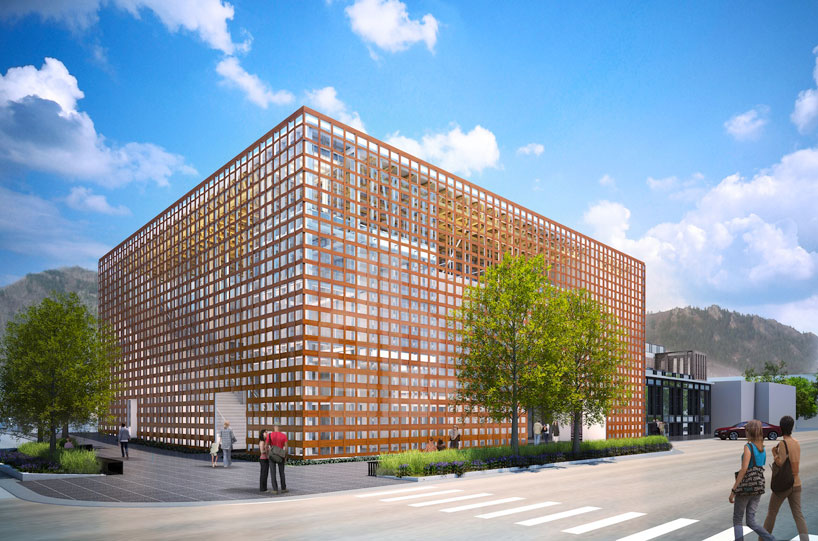
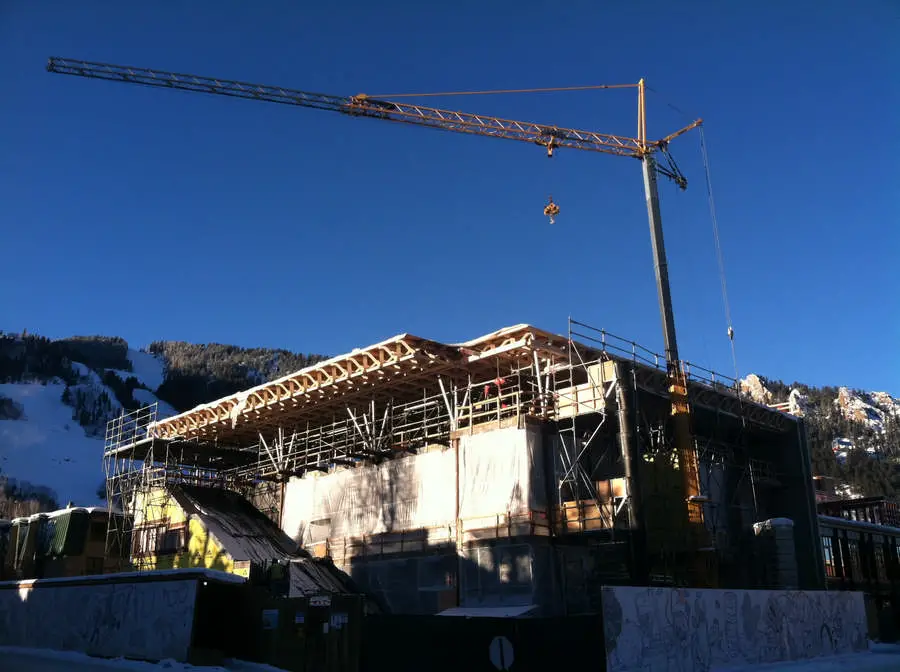
We have a new Art Museum being build in Aspen. It's been a supremely controversial process. The naysayers have been storming the castle "it's too big!" That's been the primary complaint "it's too big!"


None the less up she goes - a new architectural icon in the city a large block of man made already dripping with the promise of cutting edge avant guard wow with Shigeru Ban recently winning the Pritzker.

Walking past the construction block yesterday I couldn't help but notice how that straight edged cube cut against Aspen Mountain and reduced the ridge line of Shadow Mountain to nothing more than a frost tipped line of crenolated cake decoration. It is not another peak in the mountain range as pictured in the sketch it is a big rectangular bite of brutalism. I'm certain the Calders will be happy gently swaying on the roof and the view from the inside will be stunning but this designs mocks it's setting, and not in a nice way.


Oh, I miss the Given Institute soooooo much. That was poetry in the trees.  Take another look at Greg Watts requiem in photographs of Harry Weese's masterful humanism:

Sunday, March 23, 2014

The Time of your Life

Linda and I went to school together, so of course I read her blog and she's got a post up there now which is taking off like a rocket.


That's certainly been my philosophy for life-  no money- no workie - but my deeply held beliefs keep wobbling around  like  slow moving  squishy water balloons in the Marianus Trench.

How do you get paid?


I'm reminded of a talk by Bev Emmons when she was asked that ubiquitous question which all working women are asked, "How do you balance being a mother and a professional?" Her response was classic.  She said being a mother and a Lighting Designer teaches 2 things: 1. You always ask for a fair wage because the kids need to eat. 2. You can always recognize when your director is acting like a 2 year old. 


No, really, how do you get paid? Honestly I'd love to just do fun things the rest of my life, listen to marvelous lectures by super smart people, ski fresh powder, walk dogs through wildflowers . feast with friends and (a la Voltaire) watch my garden grow. All of that *would not make me happy* because it doesn't include *work* it doesn't include purpose.  If you don't need to work for money you need to work for sanity. Try idleness for awhile. See where it leads you. We are creatures of curiosity. We are creatures who find and solve problems. It's what we do. The trick is where you spend your most precious asset. Where do you spend your time? Ultimately that is where you've spent your life it is your work, it is your legacy.


The one thing which I do not do, nor should anyone else, is wait for opportunity to come knocking.  


That doesn't mean an orgy of extroversion or shameless self promotion. That was the mantra when I was in school- push forward! self promote! That always seemed so uncomfortable because I had been taught to let the work speak for itself.  Now with social media and crowd funding the work can speak for itself.  Just do the work, client or no, paid or no. It's the first rule of kayaking, keep paddling.   If the work doesn't have anything interesting to say… well then silence is pretty powerful feedback (hey- you- you got it wrong! Try again, try something else.) If people keep offering you **** jobs… well that's feedback too (sour attitude attracts sour clients, like finds like).

I haven't found a better expression of this than Amanda Palmer's TED talk


How do you get paid? If no one is willing to kickstart your movie or you're too intimidated to ask for pay, you might be in the wrong business, you might need to get a job frying doughnuts. That's not a step backward, that's a step towards finding your true self you'll either find the courage to push out of the fryer or you'll find the zen of frying (the 3rd option of dying old, greasy and bitter is just too banal to contemplate). 

Do the work that's true, and respect the work of others (even if they're frying doughnuts). All work is sacred and deserves respect.  


Sometimes you just have to pop the balloon.