Thursday, December 4, 2014

Lodging incentive, letter to the editor, 2014

I'm posting some old letters to the editor. This is so I can remember what I wrote, and to keep myself honest.  I'm posting them in the order I wrote them so this goes back a couple of years.

The more things change….

This is from the Summer of 2014

The City low cost lodging plan doesn't want cheap beds unless those beds are in a Lodge. The City can negotiate with Lodge Owners and Developers. There's a Lodging Association which gives you a single point of contact for negotiations. Developers can be held at gun point , oops, I meant held up at "permit point". Lodges are visible. Lodges keep records. Lodges give you numbers. Lodges fit nicely on a spreadsheet.

The individual condo or homeowner renting through Airbnb, VRBO and Homeaway is not so easy to measure. We invite Guests into our homes and try and give them a "local" Aspen experience. We are the first choice of the young and nomadic demographic. We're individuals. We don't have an Association. Our record keeping is personal. We don't have an Association or high powered Global marketing.  Our success depends entirely on word of mouth and repeat Guests.  We are the "Fringe".  We are the "sharing economy".  We're "messy".  You might even say we're "messy vitality".


The only thing the City Council has done for individual owners is try and regulate and collect a highly questionable lodging tax.  It's the lodging tax which takes my place above the $100 per person occupancy level in high season - my expenses keep it below that- just. Oh, and applying for a permit to improve the interior beyond it's 1968 glory? I could buy all the plumbing fixtures and the tile for the cost of that permit.   Taxes and permits, those effect my bottom line, not building more or building bigger or building higher.

Could we possibly try filling in the empty rooms first? Could we get a little encouragement from the City for higher occupancy in existing buildings?  Could we get a little love for the little guy? 

Affordable Housing, letter to the editor 2014

I'm posting some old letters to the editor. This is so I can remember what I wrote, and to keep myself honest.  I'm posting them in the order I wrote them so this goes back a couple of years.

The more things change….

This is from the Spring of 2014

In response to the Times article on Housing Mitigation and the following quote:

Really? Is the sole purpose of Housing Mitigation to raise more money to pay for the $100 *million* +++ Burlingame Employee Housing Development?  Judging from the work session last night (open to the public but not to public comment) those were the marching orders as Staff understood them- "find us more money"and the options Staff presented were certainly creative money makers.

Is  that really the intent of Employee Housing?  Is it supposed to squeeze those who can create jobs to the point they downsize?

But, if making more money is what we need to do…  I understand there are a few unsold units in Burlingame and in my limited experience if something isn't selling it's because there is something missing with what you're trying to sell.  Maybe if all that imagination and resourcefulness could be used to rethink the residential requirements of Employee Housing those units might sell and raise a little cash.
In last night's work session Council asked what progress had been made since the last public meetings on Housing Mitigation  and the response was "We were asked to take a step back". Wonderful, I'd love it if we would all take a step back *and* think.

The question still hangs in the smoke what would $100,000,000.00  have done for Social programs for Aspen? For Seniors? For Schools? For Homeless? For all those "soft" programs which don't involve Construction Contracts and only target Community Welfare?  Has this strategy controlled growth? Reduced free market costs? Reduced commuter traffic? Reduced down valley construction? Has it benefitted local free market Employee Rentals? Has Employee Housing kept our "cat may look at a King" demographic?

How can this system be working when SkiCo builds their Employee Housing in El Jebel and we have  (according to the Monday work session)  over 175 Accessory Dwelling Units unrented inside the City Limits of Aspen?

If we keep throwing money down the trench which is Burlingame is it really benefitting the Community or is it just supporting a Bureaucracy supporting itself?

Community Housing, letter to the editor 2013

I'm posting some old letters to the editor. This is so I can remember what I wrote, and to keep myself honest.  I'm posting them in the order I wrote them so this goes back a couple of years.

The more things change….

This is from the Winter of 2013

An opinion in response to "rental housing market deserves more attention" : Break the mold

Let's not forget that the Employee Housing program was originally supposed to house seasonal employees. The real estate market t.ook off and the City tried to grab a piece of it losing sight of the original goal. (This also had the opposite of the intended effect by making free market housing *more* $ exclusive.)

I'm in favor of Community housing, not Employee housing. By transforming the definition of seasonal employee (renter)  to full time employee (home owner) without creating a year round industry to employ them  we now have Burlingame, unsold units, aging unkept properties and retirees being asked to vacate to let seasonal employees rent.

We can continue to try and bend the system to shallow ideas or we can take a long cold hard look at the present reality and adapt (one of those Darwinian words "adapt" which is different than the verb "react")

1. Aspen is a town with a Seasonal Industry. As long as the Seasonal Industry lasts there will be a need for temporary housing (rentals). The City of Aspen has decided to help Seasonal Businesses by providing low cost housing to temporary employees. This was first attempted by Companies for their employees in the 19th century and was considered a huge innovation it was called "Social Capitalism". It is my opinion by separating Employee Housing from the fortunes of the Company we've broken that model.

2. The young, the "employable" are the least vulnerable amongst us.  It is my opinion that a Community is judged by how it treats the *most* vulnerable.

3. The more diverse a Community is the stronger it is (old, young, rich, poor, multi racial, multi cultural). It is my opinion until rich and poor rub elbows the bickering will continue and the Community will suffer. That was the Aspen which we "old farts" miss, where no one gave a hoot who you were, just if you could ski. You could be forgiven even that if you threw a good party (damn we used to have more fun).


You want to use housing quotas? Then you should include ethnicity, age and education- or just abandon the quota system.


A development without a green area or a place for kids to play shall not pass. Better yet, a development without a coffee house shall not pass. 


Bring essential services (schools and hospitals) back into the core.  As you increase the density you lower the footprint. Throw out the "zoning" rules, let pop up businesses thrive- anywhere. "Messy vitality" doesn't come from Government it comes from necessity and invention. 


Full disclosure, I have one of those "small rentals" in Aspen and it is a chunk of change to move in. The City could bring down some of my costs (taxes) and/or grant housing subsidies to Seasonal Employees.  The City *cannot* keep "playing landlord" renting/selling below cost and render the Community Services which should be it's primary responsibility.

Parking under the Park, letter to the editor 2013

I'm posting some old letters to the editor. This is so I can remember what I wrote, and to keep myself honest.  I'm posting them in the order I wrote them so this goes back a couple of years.

The more things change….

This is from the Summer of 2013

What follows is an opinion.

Oh goodie we have another issue for people to act like one year olds spoon banging their bowls of pap. The parking garage under Wagner Park is sure to bring out the entire Aspen Circus. Goodie. Give me the bears.


The buses used to stop at the corner of Mill and Hyman (x from the Wheeler) Ruby Park is better than that- but it's still a less than pleasant atmosphere in prime real estate.  Bottom line the problem of easy and immediate access the the heart of Aspen *and* keeping a restful quiet resort atmosphere is a difficult one. Ruby Park has not solved that problem. The Rio Grande city parking has not solved that problem. There may be an opportunity to correct that in the current process of redesigning and re- engineering the Rio Grande lot.

1. Digging in Aspen is always a risky proposition. Who knows, you might actually find hot water under Wagner. More likely you'll find a great archeological dig from the remains of the Clarendon Hotel or just a bunch of mine tunnels making an underground structure an engineering nightmare. You can ask the Melvilles how much trouble they had with their underground parking dig.

2. Parking Garages do not have to be NYC Port Authority concrete hell holes.


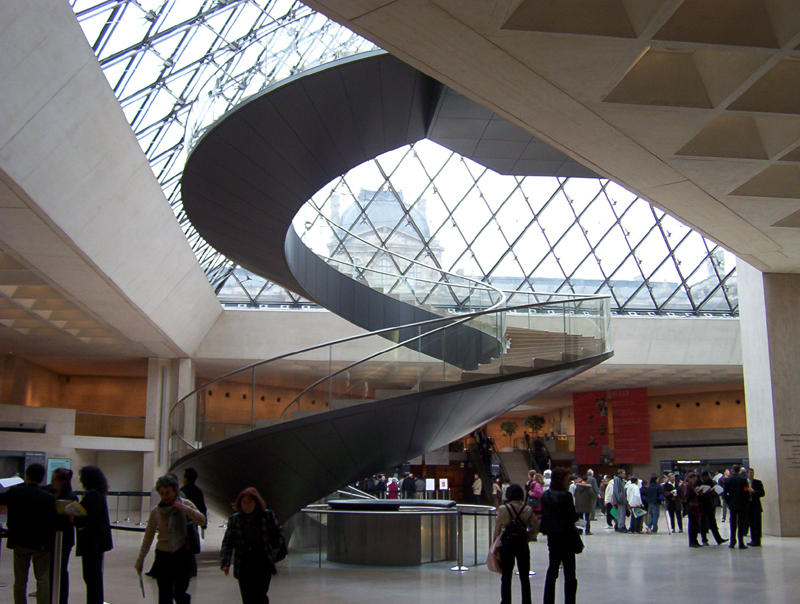
You can make a parking garage which is a pleasant experience *and* a retailers paradise. Other cities have done this with foresight and a lot of cash- but it's paid for itself in very short order. I will keep pointing to the huge success of underground parking at the Louvre which made museum entrance fees the single largest slice of the French GNP. It wasn't the pyramid which did that it was the combination of access, parking and splitting the Louvre ticket into 3 tickets (bloody brilliant).


3. Applying the theory of "service at the point of need" the only way to make Ruby Park better  is to make it a Park and reroute the buses to the Rio Grande lot. Skier buses could still stop directly at the Gondola to take skiers to the other mountains.  Yes, you would have to make a pull out for the buses but there would be fewer skiers crossing the road and it's possible the traffic flow on Durant would ease.

4. What determines how many cars use a parking structure is the vehicular entrance.  Spiraling around Monarch and Durant to an underground entrance at Wagner will not improve the traffic on Durant or in the core. The only way to do this and use Wagner would be to dig an entrance from Main street. I will win the lottery before that happens…. and to do that I have to buy a ticket.

5. What determines how people experience a parking structure is the pedestrian exit. I would *love* an exit from a parking structure right onto the mall (see above lottery quote) failing that we can make the exit from the Rio Grande so much better than it is. Just getting to the other side of Main would be a huge improvement. Retail and informational opportunities  as great or greater than those at an airport should be included.

6. Everybody thinks I'm joking when I mention underground bicycle parking- have you looked at the mall lately? It's a forest of bike racks. (granted, these may help the bears access the crab apples - or not) The Japanese robotic underground bike parking structures are *cool*.


The experience of seeing Aspen for the first time can be crafted so that those visitors who arrive feel they've reached a place where the noise and bustle of a large city has slid away. Notice I didn't say where that all the modern conveniences were gone- just the stress. That's our "product" natural beauty and a kick ass service community. The benefit of this is that we, who live here, get to enjoy that "product" year round- so it's a win win.

I sincerely believe the way to achieve this is to explore future thinking solutions like using power from hybrid/electric cars in parking structures to power the Aspen grid and reach that 100% renewable goal, like underground bicycle parking (seriously- check it out on youtube it's a kick), investigate the train again- but this time include a carrier car for trucks and vans so that deliveries can come off of 82 and onto the rails until they reach Aspen- and please make a hook up to the Ski train from Denver- if that could get skiers all the way to Aspen- Oh my.


Crazy optimistic out of the box thinking? Isn't that what we're good at here in Aspen? 

The Cost of Education in reply to Melanie Sturm, letter to the editor, 2013

I'm posting some old letters to the editor. This is so I can remember what I wrote, and to keep myself honest.  I'm posting them in the order I wrote them so this goes back a couple of years.

The more things change….

This is from the Summer of 2013 and a response to an Aspen Times Editorial from Melanie Sturm

When I think of higher education in relation to expense my question is "Who pays the most to study in a US University?" The answer has to be the International Student. I'm not just talking money (there's plenty of that) I'm talking the cost of traveling half way around the world, leaving your family, adjusting to a completely different Culture.

Why would anyone take that enormous risk without a promise of great reward?

To help me find the answer I went to the Institute of International Education which has some fascinating reports on line. What should get everyone's attention is $22+ billion dollars contributed to the US economy from foreign students. Another item of interest is that majority of our foreign students were already employed in their home country before they applied to a US University.

So, why do they come?

The report "An analysis of international students' motivations for studying in the United States." offers some insights. Yes, we rank high because of Scholarship/Grant help. But we're the hardest country (according to the survey) in which to get a Visa (Europe is much easier) and have a low rating in the "Do you feel safe?" category and we don't even get a mention for Culture and Arts. Most of our foreign students come here for Tech and Business degrees.

What's the attraction? More to the point- where do we rank higher than the EU/UK?

Although foreign students feel less safe here than in Europe they feel we are more "welcoming". They see more diversity, better facilities, and a much better chance of getting a job back home with a US degree than an EU degree. We rank high in prestige , support and quality and low on tradition. That means we're flexible- at least compared to the student's home Country.

We are still seen as a land of opportunity by the rest of the World. Now, how do we continue to offer that opportunity to our Citizens?

The suggestions of more vocational opportunities, extended time frames and digital aides (like Khan Academy) are certainly welcome. However, the fewer students the higher the tuition for those who remain.

Our current system rewards the University which is affiliated with 'for profit' and 'non- profit' partners. Their Academic status qualifies them for grants. Their non-profit partners provide a place for research to continue post-grad. The research facilities feed results to the 'for profit' company. The 'for profit' Company then donates a tax deductible scholarship to the University. When this model is really successful the 'for profit' company is a direct spin off from the non-profit (RMI and Fiber Forge*) That is how our Tech/Business schools survive and continue to grow. Even our testing programs in K-12 are geared to fit into this Tech/Business model. They don't do it well, but that's the intent.

What that leaves out of the mix is everything else, the Trades, Humanities and the Arts.

Let's play to our strengths. We're told we're more innovative, flexible and open than the rest of the world and this is the golden triangle which supports our reputation. Surely we can devise a system which is also innovative, flexible and open. We've never bought ourselves out of trouble, we need to think our way out

*note from 2014: Sadly this did not end well as I found out from a former employee when we had a long chat in the Mill Street Mall.