Showing posts sorted by relevance for query cows. Sort by date Show all posts

Tuesday, July 7, 2015

Moooooooooo…...

The experiment continues….

Last year, inspired by Alan Savory's TED talk in 2013,  I attended a grazing clinic in Boulder. Okay… you who know me can stop laughing now… I know I know … a "glazing" clinic you could believe but this was a *grazing* clinic.

So, in May 2014  thanks to Strang Ranch there were cows on the ranch ...


41 "sets" of heifers and babies to be exact. 
Yes, that's the Pulik barking ….


This year we repeated the experiment with 81 heifers, calves and yearlings … and one rather impressive bull…. 


who seemed to like his lone bull status very much….


What is the benefit of cows on a "ranch"? 

We've had an exceptional year for rain this is the gauge since May 1, 2015… in 2013 there was 6" for the entire year including snowmelt. The trick is to keep the moisture in the soil instead of it all running off and that is what mob grazing helps you do- keep the water in the soil and improve soil health.


Here's what I learned at the grazing clinic….

1. Their cloven hooves break up the hard pan and make divits where rain can soak into the soil instead of running off.

See those little puddles? Those are hoof prints.


2. They break up the old gray dead grasses and allow air and water to get to the soil.

Behind the fence there were no cows- in front of the fence- cows. 
See the dead grass around the ungrazed area?


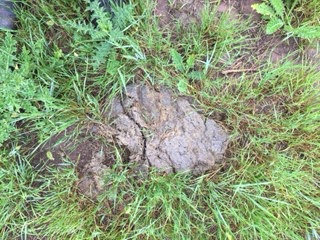
3. They leave behind free fertilizer (which the potatoes loooooove). A friend tells me she is paying for cow patties… obviously I need to explore this possible new revenue angle….


4. They're a great fire mitigation crew- mowing the grass down to a manageable height.


5. They stimulate new grass growth- as long as the grazing period is brief and the rest period is long enough for a full growing cycle in the grasses. 

compare the ungrazed area new growth grasses (green bits)
to the grazed area new growth grasses (green bits- with my shoe as a reference size)


Conclusion: the moo babies can come back and knock on the front door every spring.


Monday, June 6, 2016

3 years of Mooooooo

Last week of May and the pasture is looking good

 So here come the cows


Mowing the grass

After about a week of grazing and no rain the ground is showing.

They've cropped quite a bit 


My neighbors pasture on the left compared to my  pasture on the right: 
Right now the difference is a bit frightening.

Unlike the 2 previous years we didn't get rain during the grazing period and, although rain was predicted it's been 10 days of sun and no rain after the grazing. This will be a big test for the pasture. How will this viewpoint look in the Fall? That's the question.  

My hope is that enough of the old gray dead grass has been ground underfoot (or hoof) that when the rains do come (please let them come) the ground will be ready to soak it up instead of evaporating. 


Saturday, May 26, 2018

They're baaaaaack, moo and moo again


If you've been following for the past couple of years you'll know that I've been experimenting with grazing. The principle from the Savory Institute is simple: brief periods of intense grazing improve soil health. Since my place is a dry land  ranch I'm after any way I can to help sequester carbon in the soil and keep rain water from evaporating when it does fall.

When you compare grass fed to feedlot there isn't any question. Carbon sequestration happens with grass fed. 

So the question is- what about mob grazing compared to no grazing? Can desertification be reversed?


I reset the rain gauge in June and this is the total for the year including snowmelt. Three inches came in April.  It's not the lowest I've recorded but it's 5" below average.

After that 3 inches in April this is what we had:


Pretty impressive since the 2017 grass was dormant until this Spring.


...but after April- came May- this month has had .02" of rain- total- yes- there is a decimal point in front of the zero- that's two hundredths of an inch of rain for the month. The growth of April is already turning yellow... and the fires have already started burning....

Cows- better grass and fire mitigation all in one go..... we hope.....


Previous years of moo.

Sunday, July 24, 2022

The Great Biochar Gas Line experiment.

In 2019 the local Natural Gas Company approached me with the news they would be placing a new pipeline through my property. They were putting in a 6" line to replace the current 4" line. They expected the job to last the summer and tear up a swath about 20' wide right through the center of the meadow. Now my meadow doesn't look like much since I have no water rights and no irrigation but it's enough for the cattle in the Spring to do some fire mitigation.

Around the House and... in the Meadow
That green patch in between the sagebrush and the red barn is exactly where the gasline goes through. Not only would the pipeline nix grazing for that year but possibly several years after if the grass did not grow back after being pounded by heavy equipment for a summer.
Would it come back from this in the promised "two years?" Without irrigation? Hmmmmmmmmmmmm.......
So we made a deal- pay a bit more and use some of my land for a staging area and I'll use the cash to buy biochar compost. That way we could compare- same soil, same weather, same disturbance, but with two different rehab methods. The Gas Company would use their standard spray at the end of the job and I would put down their seed mix in biochar compost on the staging area.
The Gas Company reclamation:
Harrow the ground
October 25 2019 spray green hay and seed (no idea if the green additive was fertilizer or preservative)
By November 4 the "green" had faded
November 6 the Staging Area is bare - no harrowing here
Biochar compost on the Staging Area
Load it into the spreader with the forklift (borrowed from nextdoor and with a great deal of help from Octavio and Scott) and add the same seed mix into the spreader...
Spread it on the Staging Area
Even it out a bit...
Get some old moldy hay and spread that on top... (old and moldy so the elk don't think it's a Thanksgiving treat)
The winter of 2019-20 was one of the driest I've seen since 1996 and the summer was even drier. There wasn't a whiffle of moisture all June and then came the Grizzly Creek fire to put a cherry ontop of COVID. The conditions were "challenging" March 24, 2020 and our "moisture" for the Spring.
April 10, 2020 Pipeline: NO Biochar
April 11, 2020 Staging Area : Biochar
After a dusting of Snow on April 17... April 28, 2020 Pipeline NO Biochar
April 28, 2020 Staging Area: Biochar
May 30, 2020 Pipeline: NO Biochar
May 30, 2020 Pipeline closeup NO Biochar
May 30, 2020 Staging Area: Biochar
May 30, 2020 Staging Area closeup: Biochar
September 30. 2020 Pipeline NO Biochar
September 30, 2020 Staging Area: Biochar
April 12, 2021 Pipeline NO Biochar (even the skunk cabbage looks wilted)
April 12, 2021 Staging Area: Biochar
Two years gone. I complained- the Gas Company came back in 2021 with a water truck and spread more seed. The 2021-2022 winter was better than the previous winter. June 25, 2022 Pipeline NO Biochar
June 25, 2022 Staging Area: Biochar
Conclusion to date - 2020 was a major drought year and 2021 was better but still drought. This year 2022 seems about on track with 2021. The Biochar made a major difference in 2019-2020 and allowed grass to come back first before skunkweed and sagebrush. The pipeline reclamation may catch up if it keeps raining but it took 2 seedings and 3 waterings and there will be less grass and more sage than before even if there isn't bare ground. Bare ground in a drought goes hard as brick and doesn't let the water back in to feed the soil. The Biochar held what little water we had and gave it to the grass. Yes, one application of Biochar costs about 2X what the standard reclamation does- but if you have to come back an reapply the numbers even out and if what you get back is less suitable for grazing... well that's not optimal either. The cows haven't come back yet.